
According to Federal Trade Commission (FTC) data, scammers stole $12.5 billion from consumers in 2024, and they're counting on the holiday rush to make this year even more profitable for them. The good news? A few simple habits can keep your holidays merry and your accounts secure. Think of this as being your own Secret Santa: protecting your future self from the headache of fraud recovery.
The holiday shopping season has become a bonanza for cybercriminals. Netcraft claims that between August and October 2024, security researchers detected a 110% increase in fake shopping websites. That is over 80,000 fraudulent e-shops designed to steal your money and personal information. McAfee Labs indicates that Black Friday-themed phishing emails surged 495%. And one in three Americans admitted to falling for an online shopping scam during the holidays, with nearly one in ten losing over $1,000.
But here's what the scammers don't want you to know: their tricks are predictable. Once you understand the playbook, you can shop with confidence.
The Naughty List: scams targeting your holiday cheer
Fake shopping sites have gone professional. Scammers register domains that look almost like real retailers (Walmrt[.]com or Amaz0n-deals[.]com) and build convincing websites using stolen logos and product photos. These sites often appear in social media ads or search results, advertising luxury goods at impossibly low prices. The products either never arrive or turn out to be cheap counterfeits.
Delivery notification scams are now the most commonly reported text message fraud. You receive an urgent message claiming your package couldn't be delivered due to an "incomplete address" or "unpaid postage," with a link to resolve the issue. That link leads to a fake site designed to harvest your credit card information. USPS, FedEx, and UPS will never text you first demanding payment.
Social media ad fraud has exploded. According to FTC data, consumers lost $1.9 billion to scams initiated on social media platforms in 2024. Nearly 40% of people who purchased something through a social media ad experienced fraud. The ads feature too-good-to-be-true deals, often using AI-generated deepfake celebrity endorsements. One in five Americans unknowingly paid for fake products endorsed by deepfake videos.
Spotting Grinches before they steal your holiday
The classic warning signs: poor grammar and obvious spelling errors are becoming unreliable. Scammers now use AI to generate professional, error-free content. Instead, look for these red flags:
- Price is the biggest giveaway. If a $300 item is listed for $45, it's not a doorbuster deal, it's a trap. Legitimate retailers rarely offer discounts exceeding 50% on premium products.
- Domain age matters. Most scam sites are registered within 90 days of their attacks. Suspicious top-level domains like .shop, .vip, .xyz, and .top cost almost nothing and appear frequently in fraud operations. When in doubt, search the company name plus "scam" or "reviews" before purchasing.
- Contact information should be verifiable. Real businesses provide phone numbers, physical addresses, and clear return policies. If the only contact option is a web form and the return policy is vague or missing, shop elsewhere.
- Unsolicited urgency is always suspicious. Messages demanding immediate action, "Verify within 12 hours or your account will be closed!" are designed to bypass your critical thinking. Legitimate companies give you time to respond.
Wrapping your wallet in protection
Your choice of payment method is your first line of defense. Credit cards offer the strongest protection under federal law: most credit card issuers offer little to zero liability. If something goes wrong, you're disputing the card issuer's money, not watching your bank account drain.
Debit cards are riskier for online shopping. If compromised, criminals have direct access to your checking account. While banks eventually investigate, recovering stolen funds can take weeks, and you may be without that money over the holidays.
Virtual card numbers add another layer of protection. Many major issuers, including Capital One, Citi, and services like Apple Pay and PayPal, let you generate temporary card numbers for online purchases. If a retailer is breached, your real card number remains safe.
Never pay with gift cards, wire transfers, or cryptocurrency. These are scammer favorites precisely because they're untraceable and irreversible. No legitimate business requires these payment methods. Any request for gift card payments is a scam, full stop.
Securing the chimney: keep your network safe
Public Wi-Fi is the Grinch's favorite hangout. Coffee shop networks make it easy for attackers to intercept your data through "man-in-the-middle" attacks or fake hotspots with legitimate-sounding names. If you're shopping or banking, skip the free Wi-Fi.
Your phone's mobile data is a safer alternative. Cellular connections are encrypted and significantly harder to intercept. In a pinch, use your phone as a personal hotspot for your laptop rather than connecting to unknown networks.
If you absolutely must use public Wi-Fi, a reputable VPN helps. A Virtual Private Network (VPN) encrypts your internet traffic so people on the same network can't easily snoop on what you're doing. It is not a magic invisibility cloak, shady sites are still shady, but it does make it much harder for someone on that café network to spy on your logins or payment details. If you travel often or work from airports and hotels, a VPN is a smart extra layer.
Home network hygiene takes five minutes but protects you year-round. Change your router's default password (the factory settings are published online, hackers know them). Enable WPA3 or WPA2-AES encryption. Keep your router firmware updated. These simple steps close the most common home network vulnerabilities.
Building your Nice List: account security that works
Password reuse is the gift that keeps on giving to criminals. Over 80% of hacking-related breaches involve stolen or weak passwords. When one site is breached and your credentials are exposed, attackers automatically test those same credentials across thousands of other sites within hours.
Length beats complexity. A 14+ character passphrase like "purple-elephant-dancing-tuesday" is both easier to remember and harder to crack than "P@ssw0rd123!".
Use a password manager instead of your browser’s “remember password” pop-ups. Browsers are great for convenience, but they are not designed to be your long-term vault. If someone gets access to your laptop account, or your synced browser profile, they may get instant access to all your saved logins. A dedicated password manager encrypts your entire vault with a single strong master passphrase and is built for security first, convenience second.
Let the password manager do the heavy lifting. Good managers generate unique, random passwords for every site and auto-fill them for you. You only need to remember one strong master passphrase; the manager remembers everything else. That means:
- You never reuse passwords across shopping sites
- A breach at one retailer does not automatically endanger all of your accounts
- You can quickly update passwords if a site announces an incident
If you cannot switch everything at once, start with your “crown jewels.” Move these into a password manager first:
Your primary email account
Your bank and credit card logins
Major retailers where you have stored payment information
Then, as you shop throughout the season and log into other sites, save those credentials into the manager instead of your browser.
Multi-factor authentication (MFA) is your security elf. Enable it everywhere, but prioritize these accounts in order: your primary email (which controls password resets for everything else), financial accounts, and major retailers where you have saved payment information. Authenticator apps are more secure than SMS codes, but any MFA is dramatically better than none.
Holiday Shopping Security Checklist
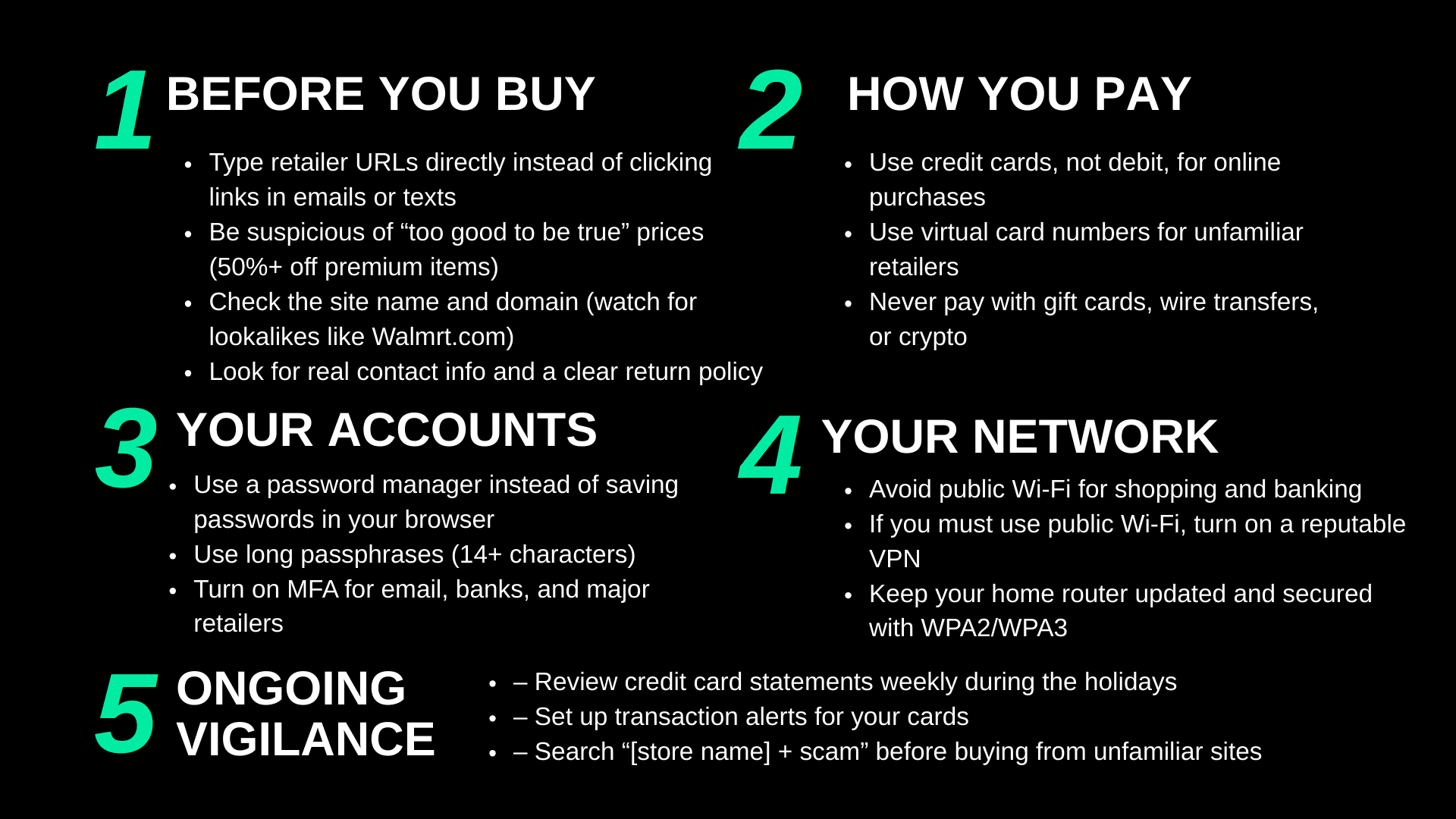
The minimum viable gift to your future self
Pressed for time? Here's the bare minimum that makes a real difference:
- Use credit cards, not debit, for all online purchases.
- Type retailer URLs directly instead of clicking email links.
- Enable MFA on your email and bank accounts.
- Avoid shopping on public Wi-Fi. If you must, use a trusted VPN.
- Let a password manager handle your logins instead of saving them in the browser.
These habits take almost no extra time and block the vast majority of holiday shopping attacks.
Level up: for those wanting extra protection
Ready to earn a spot at the top of the Nice List? Consider these additional steps:
- Use virtual card numbers for unfamiliar retailers
- Create email aliases (yourname+shopping@gmail.com) to track who shares your information
- Check unfamiliar sites using WHOIS lookup tools to verify domain age
- Review credit card statements weekly during shopping season
- Enable transaction alerts for immediate notification of purchases
- Use a reputable VPN when traveling or working on hotel/airport Wi-Fi
- Migrate your most important accounts into a password manager and disable browser password saving for those logins
If something goes wrong
Even careful shoppers occasionally encounter fraud. The key is acting quickly, victims who report within 72 hours have significantly better outcomes for fund recovery.
Contact your credit card issuer immediately to dispute unauthorized charges. Report to the FTC at ReportFraud.ftc.gov and file a complaint with the FBI's Internet Crime Complaint Center at ic3.gov for significant losses. Forward suspicious texts to 7726 (SPAM) and check your credit reports at AnnualCreditReport.com for any unauthorized accounts.
Your holiday security wrapped up
The holiday shopping season should be about finding perfect gifts for the people you love, not recovering from fraud. By staying alert to scams, protecting your payment methods, and securing your accounts, you are giving yourself the gift of peace of mind.
Be your own Secret Santa this year. Your future self will thank you.

